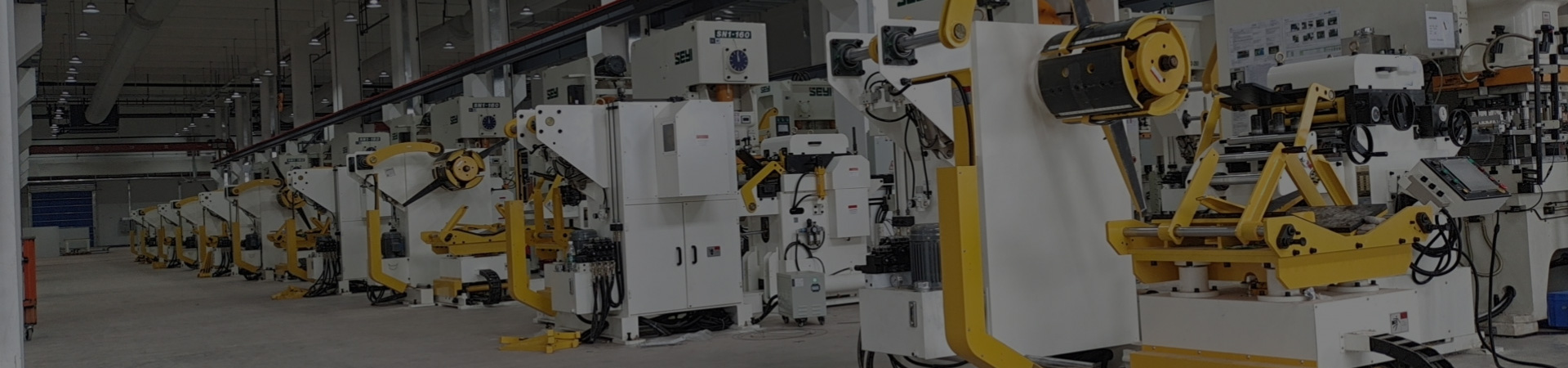
Complete High-Speed Feeding Solution for Lamination Stamping: Double Head Decoiler & S-Loop Straightener
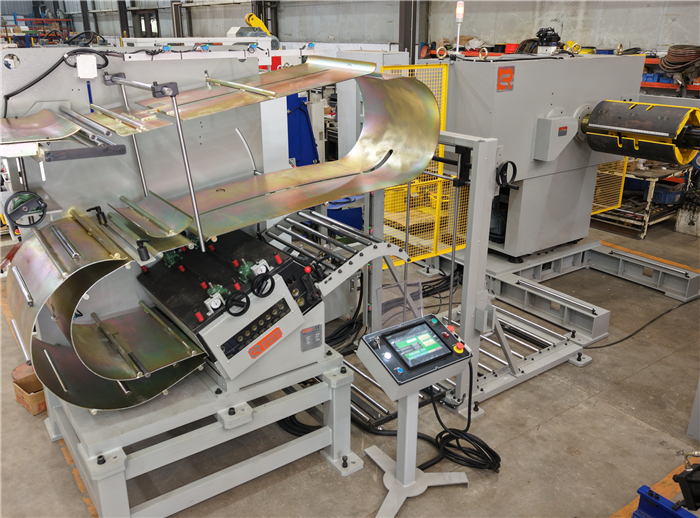
In electric motor manufacturing, lamination quality determines motor efficiency, noise levels, and performance. Our integrated Double Head Decoiler & S-Loop Straightener system delivers perfectly flat, precisely fed material at speeds up to 80m/min, enabling premium stator and rotor production.
Coil width: 700mm
Coil thickness: 0.1-1.0mm
Coil inner diameter: 475-520mm
Coil outer diameter: 1200mm
Coil weight: 5000kg per side
Coil speed: 80m/min
What Is Lamination Stamping?
Lamination stamping is a specialized metal forming process that produces thin, stamped metal sheets (laminations) stacked together to form the core of electric motors, transformers, and generators.
Key Characteristics:
Stacked Design: Multiple identical laminations are stacked and bonded to form electromagnetic cores
Insulation Coating: Each lamination has surface insulation to minimize eddy current losses
Precision Requirements: Tight tolerances (±0.02mm typical) for stacking factor and magnetic performance
High-Volume Production: Typically involves progressive dies and high-speed stamping presses
Why Laminations Instead of Solid Cores?
Reduced Eddy Currents: Thin insulated layers minimize energy loss from circulating currents
Improved Efficiency: Less heat generation means higher motor efficiency
Material Optimization: Efficient use of expensive electrical steels
What Material Is Used for Rotor Stamping?
Primary Material: Electrical Steel (Silicon Steel)
Rotor laminations typically use specialized electrical steels with specific magnetic properties:
| Material Type | Silicon Content | Thickness | Applications | Key Properties |
|---|---|---|---|---|
| Non-Oriented (NOES) | 0.5-3.2% | 0.35mm, 0.50mm, 0.65mm | General rotors, small motors | Isotropic magnetic properties |
| Semi-Processed | 0.5-1.5% | 0.50mm, 0.65mm | Cost-sensitive applications | Requires annealing after stamping |
| Fully-Processed | 2.0-3.5% | 0.35mm, 0.50mm | High-efficiency motors | Ready-to-use after stamping |
Specialty Materials:
Cobalt-Iron Alloys: For high-temperature or aerospace applications
Amorphous Metals: Ultra-thin (0.025mm) for high-frequency applications
Soft Magnetic Composites (SMCs): Powder-based for complex 3D shapes
Surface Treatments:
Organic Coatings: C-4, C-5, C-6 coatings for insulation
Inorganic Coatings: Chrome-based for high-temperature resistance
Oxide Layers: Natural oxide from annealing processes
The Ultimate Feeding Solution for High-Speed Lamination Stamping
In the high-stakes world of electric motor manufacturing, every micron matters—and every second counts. Meet the future of stator and rotor lamination production: our Double Head Decoiler with Integrated S-Loop Straightener, engineered to deliver flawless material feeding at staggering speeds of up to 80m/min.
Uninterrupted Production, Unmatched Precision
Say goodbye to downtime during coil changes. Our dual-head decoiler system allows one coil to feed the line while the next is loaded and prepared—ensuring continuous, high-speed operation without stopping. Paired with our advanced S-Loop Straightener, this system guarantees perfectly flat, stress-free material entering your stamping press, cycle after cycle.
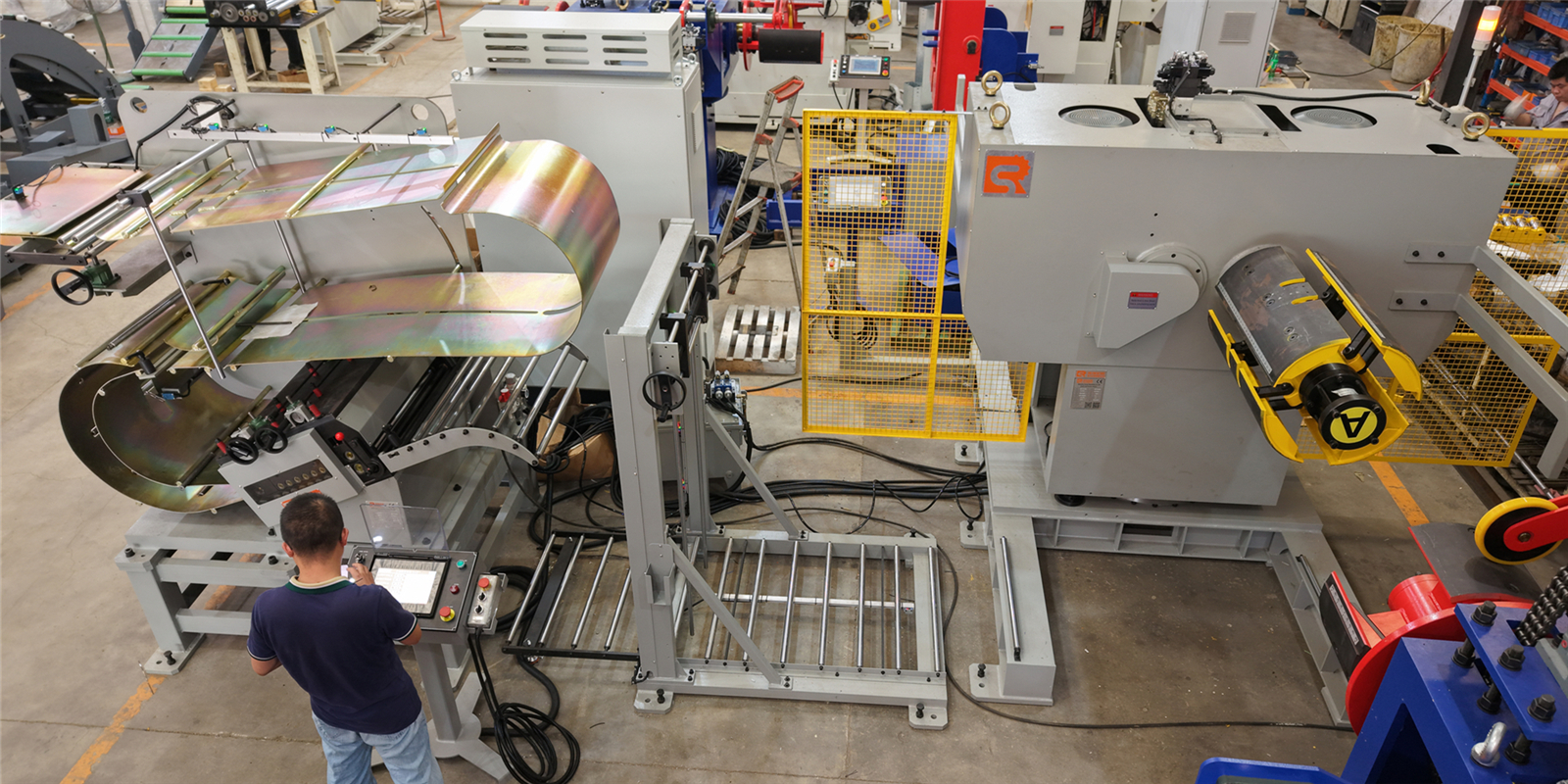
What Is the Double Head Decoiler Machine?
The Double Head Decoiler is an advanced material feeding system designed for continuous, high-volume production. Unlike traditional single-head decoilers that require the entire line to stop for coil changes, this innovative system features two independent mandrels or spindles.
How It Works:
Primary Coil Feeding: One head actively feeds the stamping press from the "running" coil.
Secondary Coil Preparation: Simultaneously, the second head holds a "ready" coil—pre-loaded, threaded, and tension-set.
Seamless Transition: When the running coil is depleted, the system automatically (or with minimal manual intervention) switches to the ready coil. The tail end of the first coil is welded or spliced to the lead of the second, ensuring uninterrupted material flow.
Key Advantages:
Zero Downtime: Eliminates production stops for coil changes
Maximized Productivity: Enables 24/7 continuous operation
Labor Efficiency: Reduces manual handling and changeover time
Material Optimization: Minimizes lead-end scrap from frequent coil changes
Ideal For: High-speed stamping applications where production continuity is critical, such as automotive motor laminations, industrial motor manufacturing, and any process requiring uninterrupted material supply.
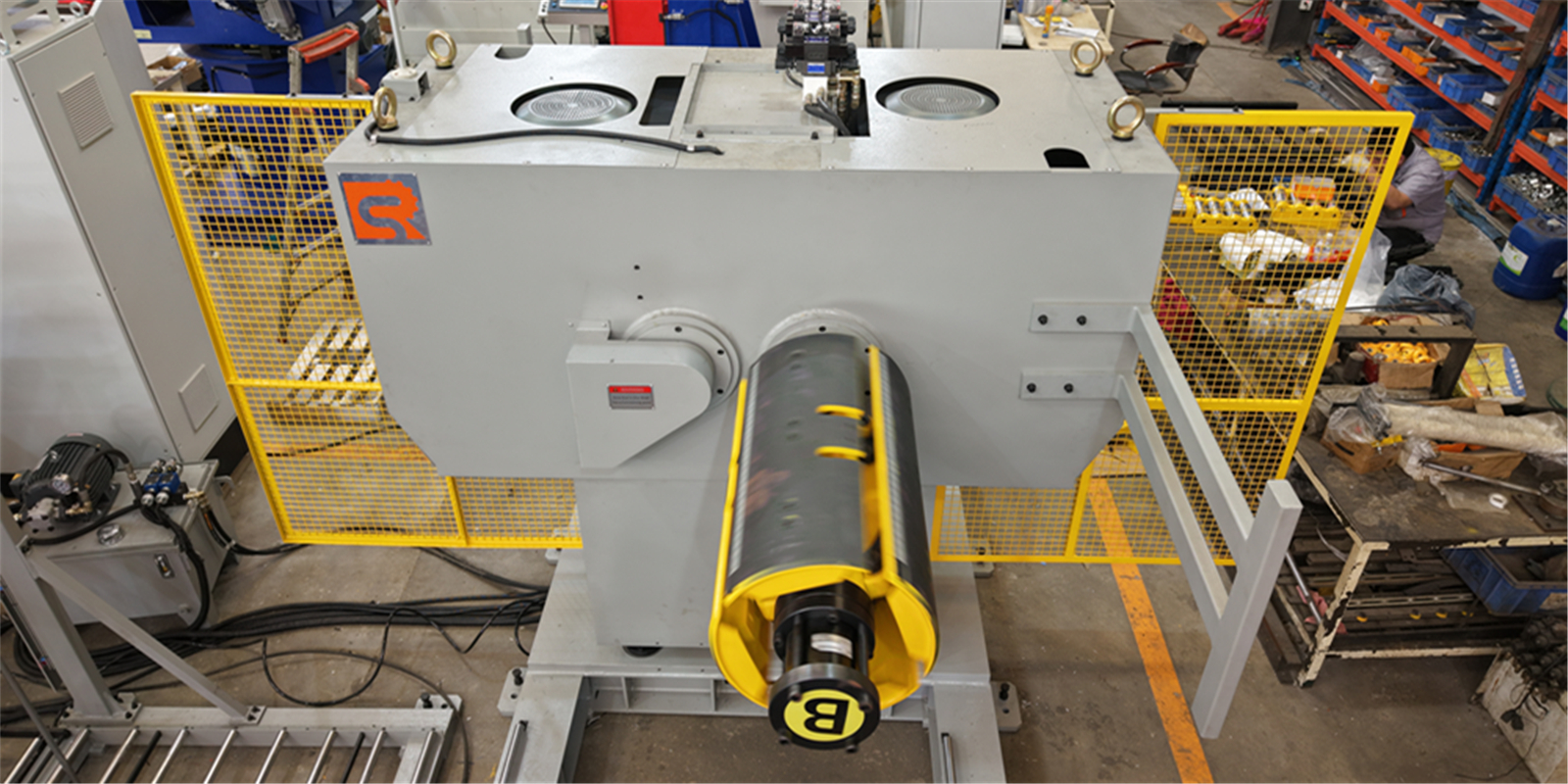
What Is the S-Loop Straightener Machine?
The S-Loop Straightener is a precision leveling system specifically engineered to eliminate internal stresses and imperfections from coiled metal stock. Its name comes from the distinctive "S" shaped path the material follows through multiple sets of straightening rollers.
How It Works:
Material Path: The metal strip enters and travels through an alternating series of upper and lower straightening rolls arranged in an S-shaped configuration.
Progressive Correction: Each set of rollers applies controlled, alternating bending stresses—first upward, then downward—which exceeds the material's yield point just enough to remove coil memory and residual stresses.
Precision Leveling: The final sets of rollers provide fine correction, ensuring the material exiting the system is perfectly flat and stress-free.
Why "S-Loop" Configuration?
Superior Straightening: The alternating bend pattern provides more effective stress relief than single-direction systems
Space Efficiency: Achieves maximum straightening performance in a compact footprint
Gentle Handling: Maintains material integrity without over-stressing or stretching
Critical Benefits for Lamination Production:
Eliminates Coil Set & Crossbow: Essential for maintaining tight stacking tolerances in laminations
Improves Die Life: Flat material reduces uneven wear on precision stamping dies
Enhances Part Quality: Ensures consistent magnetic properties across all laminations
Enables Higher Speeds: Stable, flat material flows smoothly at 80 m/min without vibration or tracking issues
The Integrated System: Why 1+1>2
When combined, these two systems create a feeding solution that outperforms traditional approaches:
At 80 m/min Operation:
Material Stability: The S-loop straightener ensures flatness is maintained even at extreme speeds
Continuous Supply: The double head decoiler guarantees material is always available without speed reduction
Synchronized Performance: Both systems are controlled by integrated electronics that maintain perfect tension and feed synchronization with your stamping press
Technical Specifications for High-Speed Operation:
Speed Range: 20-80 m/min (adjustable based on material and application)
Material Thickness: 0.2-1.0mm (optimal for laminations)
Coil Weight: Up to 10,000 kg per coil
Straightening Accuracy: Flatness within 0.5mm/m
Control System: PLC-based with touchscreen interface and press synchronization
Application Spotlight: Stator & Rotor Lamination Production
The Challenge: Lamination stamping requires exceptional flatness and dimensional consistency. Any residual stress or unevenness in the material leads to:
Poor stacking factors
Increased core loss
Reduced motor efficiency
Acoustic noise issues
Our Solution: The Double Head Decoiler with S-Loop Straightener addresses these challenges by delivering:
Consistently Flat Material: Critical for maintaining uniform insulation coating thickness
Continuous Operation: Essential for meeting high-volume production demands
Precise Feeding: Maintains perfect registration for progressive die stamping
Speed Compatibility: Keeps pace with the fastest stamping presses on the market.
ROI & Operational Benefits
For Plant Managers:
30-50% Higher Utilization: Eliminate coil change downtime
15-25% Material Savings: Reduced lead-end scrap and improved yield
Extended Tool Life: Up to 30% longer die life due to better material conditions
For Quality Engineers:
Consistent Flatness: <0.5mm/m across entire production run
Reduced Variation: Tighter stacking tolerances for better motor performance
Traceability: Complete production data logging for quality documentation
For Maintenance Teams:
Proactive Monitoring: Built-in diagnostics and wear indicators
Easy Access: Modular design for straightforward maintenance
Proven Reliability: Designed for 24/7 operation with minimal intervention
Technical Support & Integration
We provide more than just equipment:
Complete Integration: Seamless connection with your existing stamping line
Speed Optimization: Tuning services to maximize your throughput
Training Programs: Comprehensive operator and maintenance training
Remote Monitoring: Optional IoT connectivity for predictive maintenance
Ready to Transform Your Production?
The combination of Double Head Decoiler and S-Loop Straightener represents the gold standard in lamination production feeding technology. When processing electrical steels for stator and rotor applications at speeds up to 80 m/min, this system delivers:
Uninterrupted Production through seamless coil changes
Perfect Material Flatness for optimal stacking and magnetic performance
Maximum Press Utilization by eliminating feeding bottlenecks
Consistent Quality across millions of laminations
Whether you're producing automotive EV motors, industrial drives, or precision appliances, our integrated feeding solution provides the reliability, speed, and precision needed to compete in today's demanding markets.
Ready to optimize your lamination production? Contact our engineering team for a comprehensive analysis of how our 80 m/min feeding system can transform your manufacturing process.
High-Speed Feeding Solution for Lamination Stamping: Double Head Decoiler & S-Loop Straightener Video