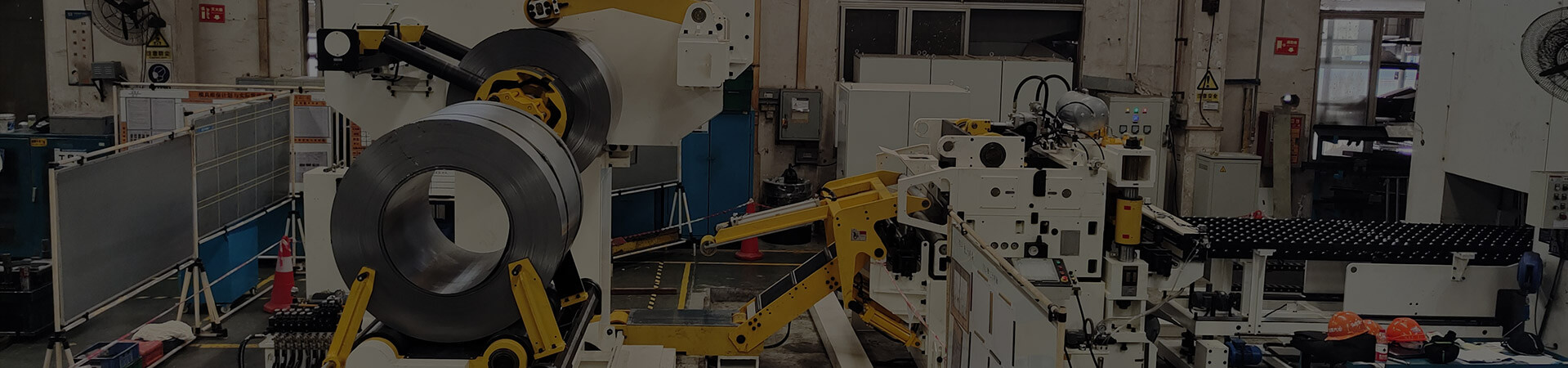
Decoiler Straightener Feeder
The SUNRUI 3-in-1 decoiler straightener feeder is an integrated coil processing system that combines decoiling (unwinding), precision straightening (leveling), and servo feeding into a single, compact unit . By merging these three critical functions, the system eliminates the need for separate machines and long material loops, delivering significant benefits in floor space savings, setup efficiency, and feeding accuracy.
This "short-space design" was developed specifically to meet the needs of manufacturers with limited production floor space. By positioning the straightener-feeder directly at the press and drawing material from a small loop below the decoiler, the system can reduce overall line length to as little as 4.5 meters—saving up to 40-50% floor space compared to traditional modular lines . This compact footprint makes the 3-in-1 system an ideal solution for both new line installations and retrofitting existing press workshops.
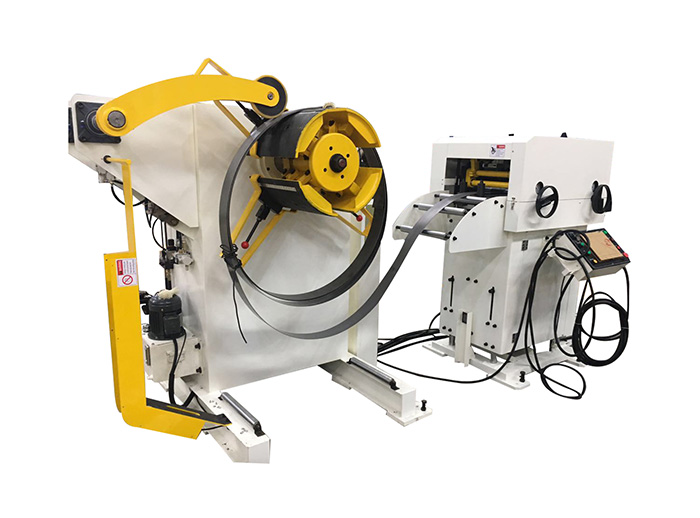
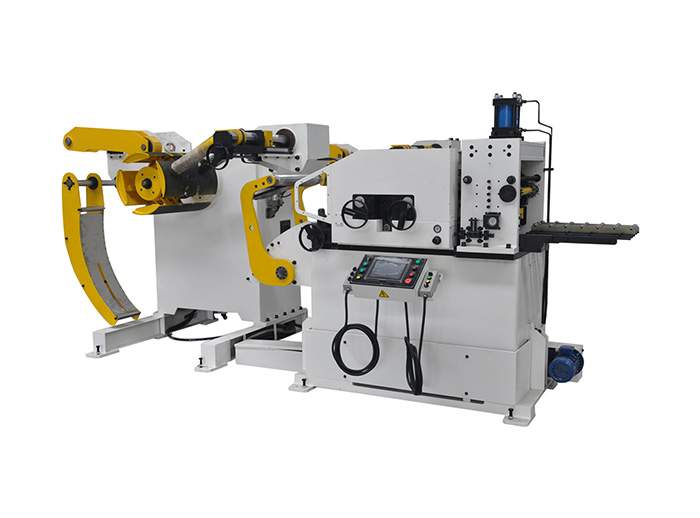
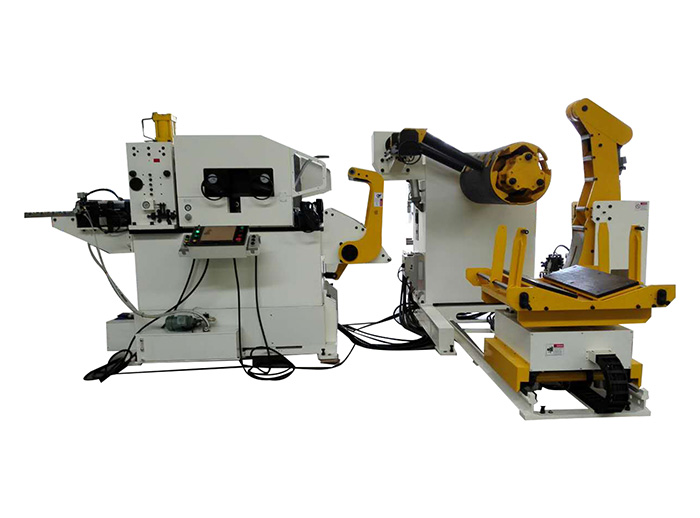
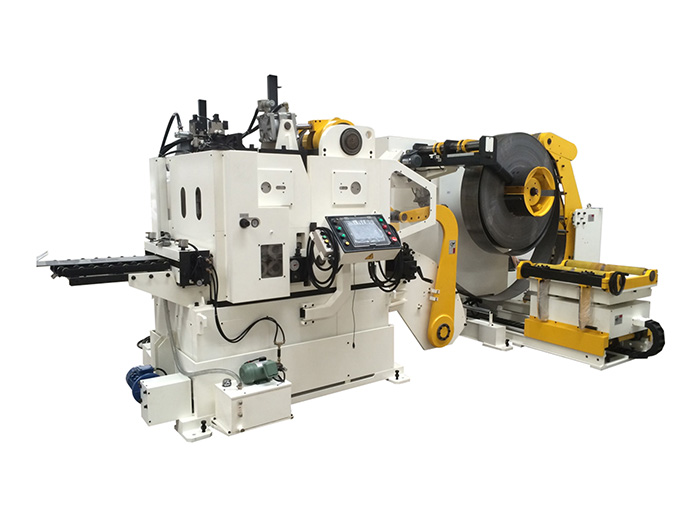
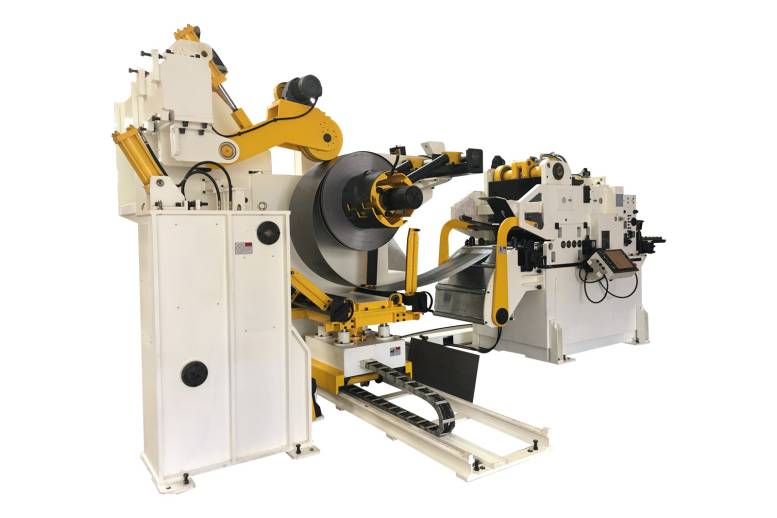
SUNRUI 3-in-1 Decoiler Straightener Feeder | Integrated Coil Feeding for High-Performance Stamping
Integrated Design, Superior Performance
The 3-in-1 coil feeding system works through the seamless integration of three core components :
| Component | Function |
|---|---|
| Decoiler (Uncoiler) | Holds the heavy metal coil (steel, aluminum, copper, etc.) on a hydraulic expansion mandrel and unwinds the material in a controlled manner. Features include a pneumatic press arm to prevent coil loosening, support arms for strip guidance, and an electric eye loop control system for automatic speed adjustment . |
| Straightener (Leveler) | Removes coil set, curvature, and surface irregularities from the uncoiled strip. Uses a series of precision-ground rollers (typically 7 or 9,or 11 upper and lower rollers) made from GCr15 bearing steel, hardened to HRC58-62° and hard-chrome plated for wear resistance. Back-up rollers are available for high-strength materials . |
| Servo Feeder | Accurately feeds the straightened material into the stamping press at a consistent length and speed. Powered by a Yaskawa servo motor and controlled by a Mitsubishi PLC, the feeder achieves a repeatable feeding accuracy of ±0.15mm through a closed-loop encoder feedback circuit . |
Space-Saving Integration: Combines three machines into one compact unit, significantly reducing the required workshop footprint .
High Precision Feeding: Yaskawa servo system and Mitsubishi PLC deliver ±0.15mm feeding accuracy, critical for progressive die stamping .
Versatile Material Handling: Processes a wide range of materials including high-strength steel, stainless steel, galvanized steel, aluminum, and copper, with coil widths from 70mm to 1800mm and thicknesses from 0.3mm to 12mm (depending on model) .
Robust Construction: All straightening and feeding rollers are made from GCr15 bearing steel, heat-treated to HRC58-62°, hard-chrome plated, and precision-ground for extended service life .
Efficient Operation: Features a user-friendly HMI touchscreen for setting feed lengths, automatic loop control, and optional flip-top design for easy roller cleaning .
CE Certified: All systems meet European safety and quality standards, with core components from global brands (Japan Yaskawa, Mitsubishi)
Applications
SUNRUI3-in-1 coil feeding systems are widely used in industries requiring high-volume, precision metal stamping :
Automotive: Brake pads, seat slide rails, front and center pillars, structural parts, body panels .
Appliance Manufacturing: Air conditioner chassis, refrigerator panels, washing machine components .
Electronics & Hardware: Connectors, terminals, computer hardware, mobile phone parts .
Construction: Building hardware, structural profiles, shelving components
SUNRUI 3 IN 1 decoiler straightener feeder --- Frequently Asked Questions
I. Selection & Configuration
Q: How does a3-in-1 decoiler straightener feeder save space compared totraditional lines?
A: A 3-in-1 coil feeding system integrates all three functions into a single chassis, eliminating the need for a long slack loop between the straightener and feeder that is required in modular lines. This can reduce the overall line length by several meters, saving up to 40-50% floor space. The compact "short-space" design developed by SUNRUI and other manufacturers eliminates separate loop pits or buffer zones, making it ideal for space-constrained workshops.
Q: Can a 3-in-1 decoiler straightener feeder be integrated with any press machine?
A: Yes. Modern 3-in-1 coil feeding systems are designed with universal synchronization interfaces. They can communicate with almost any brand of mechanical or hydraulic press via cam signals or encoder linkages to ensure seamless operation. SUNRUI systems, for example, have been successfully integrated with presses up to 1250 tons capacity from major brands including AIDA, Komatsu, and Schuler.
Q: What is the difference between a 3-in-1 integrated system and a traditional modular coil line?
A: The key differences are summarized below:
| Feature | 3-in-1 Integrated Feeder | Traditional Modular Coil Feed Line |
|---|---|---|
| Footprint | Extremely compact; saves 40-50% floor space | Significantly larger; requires space for separate units and loop pits |
| Control | Unified control via a single PLC; perfect synchronization | Multiple independent controls; precision depends on tuning of separate drives |
| Precision | Inherently high; driven by a synchronized system | Variable; can be excellent but requires meticulous setup |
| Flexibility | Best for dedicated, high-volume production | Better for custom layouts and easier component upgrades |
II. Operation & Adjustment
Q: How do I adjust the feed height to align with my press?
A: To perfectly align with your stamping press's die height, the feed height of the 3-in-1 system must be precisely adjusted.
Follow these steps:
1. Loosen the 4 locking bolts on both the left and right sides of the machine.
2. Use the "Table Up" or "Table Down" buttons on the control panel to adjust the height to the exact position required by your die.
3. Once the correct height is achieved, securely tighten all 4 locking bolts.
Important: Always loosen the locking bolts before using the control panel buttons to adjust height.
Q: How do I set the straightening (leveling) amount for different material thicknesses?
A: The straightening amount—the opening gap between upper and lower rollers—directly impacts material flatness. The optimal setting depends on material thickness, alloy type, width, and the degree of coil set (curvature).
Key technique: Set the straightening amount at the inlet end slightly less than at the outlet end. Adjust while running the feeder servo motor forward and reverse (manual mode), repeatedly fine-tuning until the material exits perfectly straight and flat.
Q: How do I adjust the feed roller pressure?
A: Feed roller pressure must be adjusted according to your specific material type and thickness:
1. Pull the adjustment knob outward (exposing the orange mark).
2. Rotate the knob: Clockwise increases roller pressure; Counter-clockwise decreases pressure.
3. After setting, push the adjustment knob firmly inward to lock it (orange mark disappears).
Troubleshooting tip: If material slippage or inaccurate feeding occurs, insufficient feed roller pressure is likely. Conversely, visible roller marks or indentations indicate excessive pressure.
Q: What is the maximum material thickness a 3-in-1 system can handle?
A: The capacity depends on the model. Standard models typically handle up to 3.2mm, while heavy-duty versions can process high-strength plates up to 9.0mm or even 12mm thick. SUNRUI'sMFL5 series, for example, handles 0.8-9.0mm thickness for thick plate stamping applications.
Q: Why does the material not track on-center?
A: Material tracking problems typically result from:
1. Misalignment – The straightener is not centered on the coil and reel. Reposition as needed.
2. Incorrect stock guides – Verify that guides are centered on the straightener and reposition if required.
3. Non-parallel pinch rolls – Verify pinch rolls are parallel and realign if necessary.
4. Non-parallel upper straightening rolls – Check and adjust roll parallelism.
III. Material & Process
Q: What materials can a 3-in-1 coil feeding system handle?
A: 3-in-1 systems are highly versatile and can process a wide range of materials including:
Cold-rolled and hot-rolled steel – standard configuration
Galvanized steel – standard configuration
Stainless steel – requires hardened rollers (HRC58-60°)
High-strength steel (HSS) – up to 630-980 N/mm² yield strength with heavy-duty models
Aluminum – recommended with PU rollers to prevent surface scratching
Copper and Brass – recommended with PU rollers for surface protection
Q: Will the straightening process leave marks on soft materials like aluminum?
A: Standard steel rollers can leave marks on soft or polished materials. For such applications, SUNRUI offers PU (polyurethane) coated rollers as an option. The soft PU material grips without scratching, making it ideal for aluminum, brass, copper, and pre-coated metals.
Q: How do I prevent material surface scratches or roller marks?
A: To maintain surface quality:
1. Use PU rollers for soft or coated materials
2. Clean rollers regularly – wipe before each shift to remove debris and buildup
3. Check for foreign particles – inspect material surface for welding slag, sand, or rust before feeding
4. Adjust pressure properly – excessive roller pressure can cause marking
5. Consider protective film – for highly sensitive surfaces
Q: My material has scratches or marks on the surface. What should I do?
A: Scratches and marks are typically caused by:
1. Buildup on pinch rolls or straightening rolls – Clean with solvent or emery cloth
2. Excessive roll pressure – Adjust pressure gradually, especially for soft or coated materials
3. Foreign particles on the roller surface – Remove welding slag, sand, or rust before feeding material
Important: Never feed material thicker than the machine's nameplate limit—this can permanently damage rollers.
IV. Maintenance & Troubleshooting
Q: What is the recommended maintenance schedule for a 3-in-1 coil feeding system?
A: Regular preventive maintenance extends equipment service life and ensures consistent performance:
| Maintenance Task | Frequency |
|---|---|
| Roller surface cleaning | Daily (or after each shift) |
| Visual inspection of all systems for proper pressures | Daily |
| Check all air lines and hydraulic hoses for leaks | Daily |
| Lubrication of moving parts | Daily/Weekly |
| Clean air line filter bowls | Weekly |
| Check belts and pulleys | Weekly |
| Check oil level in gear reducers | Monthly |
| Clean all motor cooling fans | Monthly |
| Full machine audit and calibration | Annually |
Q: What should I check if the machine makes unusual noise or vibrates?
A: Excessive noise or vibration can indicate:
1. Worn bearings – Listen for clicking sounds; check bearing temperature (stop if >60°C)
2. Loose components – Inspect and tighten all bolts and fasteners
3. Material debris – Check for foreign particles on rollers or guides
4. Imbalance – Reduce feed speed to see if vibration decreases; if so, check roll balance
Q: Why is the material not feeding smoothly?
A: Common causes and solutions:
1.Incorrect roll gap – Re-set roll gaps according to material thickness
2.Uneven roll pressure – Check pressure distribution across the width and adjust evenly
3.Worn or damaged rollers – Inspect for scratches, dents, or uneven surfaces—replace if necessary
4.Material exceeding machine capacity – Verify that thickness and width are within specification
5. Insufficient straightening passes – Reduce feed speed or increase number of passes
Q: How do I switch between different coil sizes?
A: Modern 3-in-1 systems feature hydraulic expansion mandrels and motorized coil cars that make loading and centering new coils fast and safe, significantly reducing changeover time compared to manual systems. For manufacturers requiring frequent coil changes, a double-head decoiler configuration can reduce changeover time from minutes to under 30 seconds by pre-loading a standby coil.
Q: How does the system maintain precision at high speeds?
A: Precision is maintained through:
1. High-torque Yaskawa or Mitsubishi servo motors with closed-loop encoder feedback
2. Precision-ground straightening rollers (GCr15 bearing steel, HRC58-62°)
3. Integrated control system that continuously monitors feeding length to ensure zero-cumulative error even during high-speed stamping cycles
Q: Does SUNRUI provide operator training with the purchase?
A: Yes. SUNRUI provides comprehensive on-site operator training as part of the implementation service. Technical engineers teach operators how to perform proper setup and alignment, adjust straightening parameters, change coils safely, perform routine maintenance, and troubleshoot common issues. Training ensures operators can maximize the system's capabilities from day one.
Ready to Optimize Your Stamping Line? Let's Talk.Choosing the right coil feeding system is a critical decision for your production efficiency and bottom line. Whether you are planning a new line, upgrading an existing press, or simply exploring your options, the SUNRUI team is here to help.How can we assist you today?
Email:info@sz-sunrui.com (for general inquiries and quotes)
Phone: +86-13510169882 (available during business hours)
Online Inquiry: Fill out the form below and we will respond within one business day.
Contact our team today. We'll help you find the right 3-in-1 solution for your stamping line.