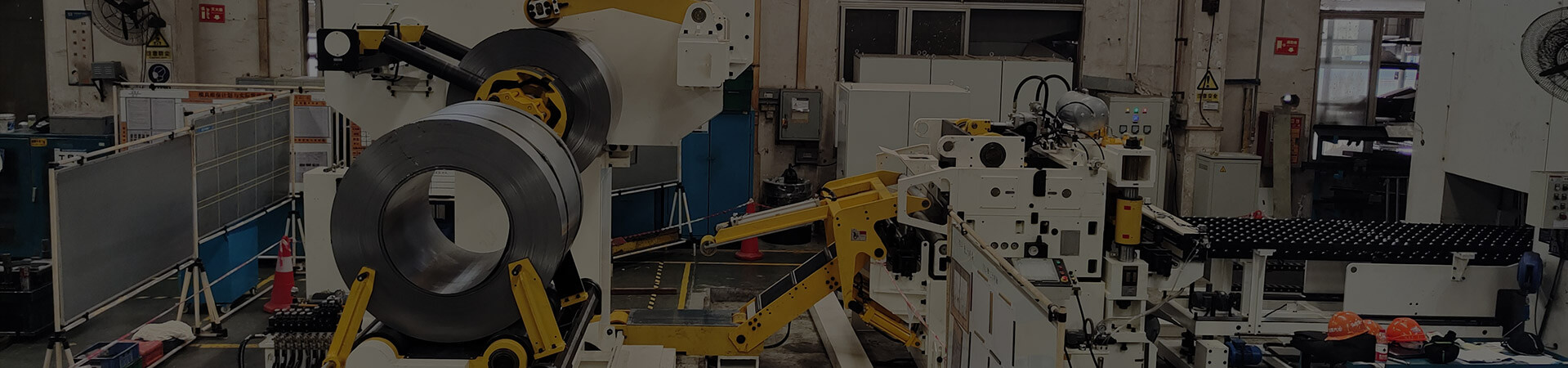
Coil Blanking Line
SUNRUI MACHINE manufactures high-performance coil blanking lines designed to convert metal coils into precision flat blanks with exceptional accuracy and efficiency. Our blanking lines integrate decoiling, straightening, feeding, stamping, and stacking into a fully synchronized production flow, delivering consistent blank quality for automotive body panels, structural components, appliance parts, and general metal stamping applications.
With over two decades of engineering expertise, SUNRUI blanking lines are built to handle a wide range of materials - from mild steel and galvanized sheets to high-strength low-alloy (HSLA) and advanced high-strength steel (AHSS) up to 1180 MPa tensile strength. Our systems are engineered for 24/7 continuous operation, combining rugged construction with servo-driven precision to maximize uptime and minimize scrap rates.Whether you are a Tier 1 automotive supplier, an appliance manufacturer, or a metal stamping facility, SUNRUI provides customized blanking line solutions tailored to your specific coil width, thickness, blank size, and production volume requirements.
Key Technical Specifications
SUNRUI coil blanking lines are available in multiple configurations to match diverse production requirements. Below are the standard specification ranges:
| Parameter | Specification Range |
|---|---|
| Material Types | Cold-rolled steel, hot-rolled pickled steel, galvanized steel, HSLA, AHSS, aluminum, stainless steel |
| Material Thickness | 0.3mm - 6.0mm (mild steel); up to 3.6mm (AHSS) |
| Coil Width | 150mm - 2000mm |
| Coil Weight | Up to 30,000 kg |
| Coil Inner Diameter | Φ450mm - Φ610mm (customizable) |
| Coil Outer Diameter | Φ1200mm - Φ2000mm |
| Blank Length | 40mm - 4000mm |
| Length Accuracy | ±0.15mm (≤500mm); ±0.3mm (≤1000mm) |
| Line Speed | 0 - 80 m/min (depending on material and blank size) |
| Press Speed | 15 - 80 SPM |
| Yield Strength | Up to 980 N/mm² |
| Tensile Strength | Up to 1180 N/mm² |
Custom configurations are available for specific production requirements. Contact our engineering team for a personalized solution.
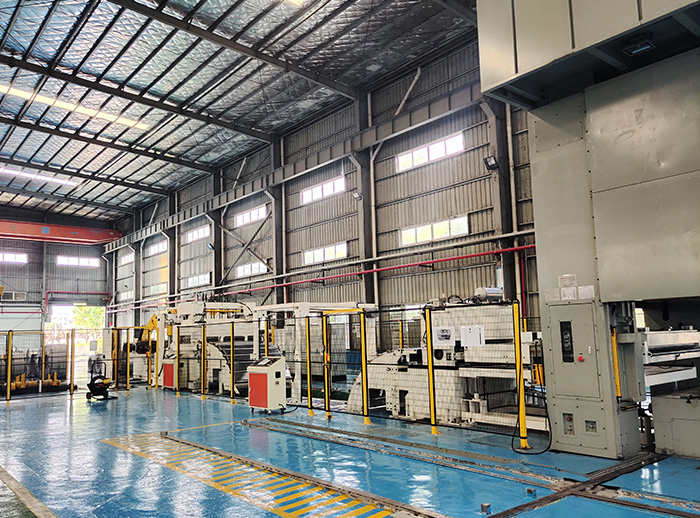
Key Engineering Features and Advantages
SUNRUI coil blanking lines incorporate advanced engineering features that deliver measurable operational benefits:
High-Precision Servo Feeding
Equipped with Japanese servo motors and CNC control systems, our blanking lines achieve feeding accuracy of ±0.1mm, ensuring consistent blank dimensions and minimizing material waste. The servo system supports high-frequency start-stop cycles required for high-speed blanking operations.
Superior Leveling Performance
The six-high or seven-high roller straightener, combined with universal joint full-shaft drive, ensures optimal flatness across the full coil width. Hard chrome-plated rollers provide extended wear resistance and maintain surface quality of sensitive materials.
Intelligent Loop Control
Ultrasonic loop control sensors continuously monitor material loop height and automatically adjust decoiler speed in real time. This eliminates the need for mechanical contact sensors, reduces maintenance, and ensures seamless synchronization between decoiler, straightener, and press.
Heavy-Duty Construction for AHSS
With increasing demand for advanced high-strength steel in automotive lightweighting, SUNRUI blanking lines are engineered with robust hold-down arms and enhanced structural rigidity to safely handle materials with yield strength up to 980 N/mm² and tensile strength up to 1180 N/mm².
Automated Coil Loading and Centering
The hydraulic coil car with ultrasonic self-centering system enables fast, safe, and accurate coil loading. Operators can load coils up to 30 tons with minimal manual intervention, reducing changeover time and eliminating the safety risks of manual alignment.
User-Friendly Operation and Safety
The high-definition HMI touchscreen interface and comprehensive safety protection system make operation intuitive even for inexperienced operators. Automatic fault diagnosis assists in rapid troubleshooting, while enhanced safety features ensure compliance with international standards.
Materials Processed
SUNRUI coil blanking lines are capable of processing a wide range of materials:
Cold-rolled steel (CR)
Hot-rolled pickled steel (HRPO)
Galvanized steel (GI, GA)
High-strength low-alloy steel (HSLA)
Advanced high-strength steel (AHSS) up to 1180 MPa
Aluminum and aluminum alloys
Stainless steel
Coated and painted steel sheets
Industry Applications
Our blanking lines serve diverse industries with specific application requirements:
SUNRUI coil blanking lines are capable of processing a wide range of materials:
Body panels (doors, hoods, roofs, fenders)
Structural components (B-pillars, reinforcements)
Chassis parts and suspension components
Interior and seating structures
Appliance Manufacturing
Hardware and fasteners
Agricultural equipment parts
Construction components
Electrical enclosure panels
Hardware and fasteners
Agricultural equipment parts
Construction components
Electrical enclosure panels
Why Choose SUNRUI MACHINE for Your Blanking Line?
Engineering Expertise
With over 20 years of experience in coil processing equipment, SUNRUI MACHINE has engineered and delivered hundreds of blanking lines to customers across automotive, appliance, and general manufacturing sectors. Our engineering team provides end-to-end support from concept design to installation and commissioning.
Customized Solutions
Every production line is unique. We work closely with each customer to understand their specific material requirements, production targets, and facility constraints, delivering custom-engineered blanking lines that precisely match their needs.
Global Quality Standards
SUNRUI blanking lines are manufactured in our 20,000+ sqm facility under rigorous quality control processes. All equipment meets or exceeds international standards, with CE certification available for European markets.
Comprehensive After-Sales Support
On-site installation and commissioning
Operator and maintenance training
Rapid spare parts dispatch (24-48 hours for critical components)
Remote diagnostic support
Warranty coverage and extended service contracts
Our blanking lines are operating successfully in facilities across Asia, Europe, the Americas, and the Middle East, processing millions of tons of metal coils annually.
Q1: How do I determine the right blanking line capacity for my production needs?
To determine the appropriate blanking line capacity, you should analyze your maximum coil weight, the widest and thickest material you intend to process, and your required daily output. SUNRUI engineers work with you to size each component—decoiler, straightener, feed system, press, and stacker—to handle your peak loads efficiently without over-investing in unnecessary capacity.
Key parameters to evaluate include:
Coil weight (up to 30,000 kg for standard lines)
Material thickness (0.3mm - 6.0mm for mild steel; up to 3.6mm for AHSS)
Coil width (150mm - 2000mm)
Blank length range (40mm - 4000mm)
Target production speed (15 - 80 SPM)
Contact our engineering team with your specific requirements for a tailored sizing recommendation.
Q2: What materials can SUNRUI blanking lines process?
SUNRUI blanking lines are capable of processing a wide range of materials:
Japanese servo motors with CNC control for high-frequency start-stop feeding
Precision-ground roller straighteners with universal joint full-shaft drive
Ultrasonic loop control for real-time speed synchronization
For automotive applications where dimensional consistency is critical for subsequent stamping operations, our blanking lines deliver the repeatable accuracy required for Class A surface panels and structural components.
Q3: What is the difference between a cut-to-length line and a blanking line?
A cut-to-length (CTL) line produces standard-sized sheets that often require additional shearing before use. A blanking line, by contrast, creates blanks cut to specific close tolerances, ready for the next manufacturing step without additional processing. The main difference lies in the precision of the cutting process—blanking lines use advanced feed systems and precision dies to produce blanks with tight tolerances (±0.1mm or better), whereas CTL lines focus on producing sheets at lower precision requirements.
Technical Performance & Accuracy
Q4: What cutting accuracy can I expect from a SUNRUI blanking line?
SUNRUI blanking lines achieve length accuracy up to ±0.1mm (for blank lengths ≤ 500mm) and ±0.3mm (for blank lengths ≤ 1000mm), depending on material type and thickness. This precision is enabled by:
Japanese servo motors with CNC control for high-frequency start-stop feeding
Precision-ground roller straighteners with universal joint full-shaft drive
Ultrasonic loop control for real-time speed synchronization
For automotive applications requiring O5-grade surface quality (exposed panels), we offer specialized configurations with additional surface protection features.
Q5: How does SUNRUI ensure flatness and surface quality of blanks?
Blank flatness and surface quality are ensured through multiple engineering measures:
Six-high or seven-high roller straighteners with hard chrome-plated rollers for extended wear resistance and optimal flatness across the full coil width
Precision leveling adjustment for thickness variations to eliminate coil set and residual stress
Magnetic or vacuum stacking systems that handle blanks without scratching or marking sensitive surfaces
Quality monitoring sensors for real-time surface inspection on advanced models.
For automotive applications requiring O5-grade surface quality (exposed panels), we offer specialized configurations with additional surface protection features.
Q6: Can SUNRUI blanking lines handle AHSS (advanced high-strength steel)?
Yes. SUNRUI blanking lines are specifically engineered to handle AHSS with yield strength up to 980 N/mm² and tensile strength up to 1180 N/mm².
Key adaptations include:
Reinforced structural rigidity to withstand higher forming forces
Hydraulic hold-down arms with pressure control to prevent high-tensile materials from springing back during decoiling
Enhanced roller straightener configurations for AHSS spring-back compensation
Heavy-duty servo feed systems capable of handling increased material resistance
As automotive lightweighting drives increasing adoption of AHSS, SUNRUI continuously upgrades our blanking line designs to meet these demanding requirements.
Installation & Integration
Q7: What are the facility requirements for installing a SUNRUI blanking line?
Before installation, we recommend evaluating the following facility readiness:
PLC communication with major brands (Siemens, Mitsubishi)
Integration with upstream coil storage and downstream stamping presses
Remote monitoring and diagnostic capability for centralized production control
We work with your engineering team to ensure compatibility before finalizing the design.
Q8: Can a SUNRUI blanking line be integrated with my existing production equipment?
Yes. SUNRUI blanking lines are designed with modular architecture and standard communication interfaces (Profibus, Ethernet/IP, etc.) for seamless integration with existing presses, feeders, and factory automation systems.
Our control systems support:
PLC communication with major brands (Siemens, Mitsubishi)
Integration with upstream coil storage and downstream stamping presses
Remote monitoring and diagnostic capability for centralized production control
We work with your engineering team to ensure compatibility before finalizing the design.
Operation & Maintenance
Q9: What maintenance does a blanking line require?
Regular maintenance is essential for optimal performance and longevity.
SUNRUI recommends:
Feeding inaccuracy: Older mechanical feeders struggle with precise length control. SUNRUI solves this with servo-driven feed systems and CNC control.
Poor leveling performance: Insufficient straightening causes residual stress and sheet waviness. SUNRUI uses six-high/seven-high roller configurations with precision adjustment.
Frequent downtime: Aging lines require manual adjustments and experience mechanical wear. SUNRUI lines feature heavy-duty construction and automated diagnostics to minimize unplanned stops.
Low automation level: Manual stacking increases labor costs and safety risks. SUNRUI offers fully automated stacking and palletizing systems.
ROI & Investment
Q11: What is the typical return on investment for a SUNRUI blanking line?
The ROI for a blanking line investment typically comes from four primary sources:
On-site installation and commissioning by our experienced engineers
Operator and maintenance training at your facility
Remote diagnostic support for rapid troubleshooting (typically within 24 hours)
Rapid spare parts dispatch (24-48 hours for critical components)
Warranty coverage with extended service contract options
Lifetime technical support and upgrades
All critical wear parts use internationally standard components available locally, minimizing downtime for replacement.
Q13: Do you offer customization for specific blank shapes or production requirements?
Yes. SUNRUI provides extensive customization options:
Blank shape: Rectangular, circular (circle blanking lines), or custom profiles
Material handling: Specialized configurations for delicate materials (aluminum, coated steels, O5-grade automotive steels)
Stacking systems: Magnetic, vacuum, or mechanical options based on blank size and material
Automation level: From semi-automatic to fully automated lights-out production
Control system: Custom PLC programming and HMI interfaces to match your existing line
Send us your specific requirements, and our engineering team will design a solution that precisely matches your needs.
Q14: What is the typical lead time for a SUNRUI coil blanking line?
Lead times vary based on the specific configuration, customization level, and current production schedule. Standard blanking lines typically ship within 8-12 weeks from order confirmation. Custom-engineered solutions may require 16-24 weeks depending on complexity. Contact our sales team for current lead time estimates for your specific requirements.
Ready to Upgrade Your Blanking Production?
Explore our detailed blanking line specifications and configuration options below, or contact our engineering team to discuss your specific production requirements.
Send us your specific requirements, and our engineering team will design a solution that precisely matches your needs.