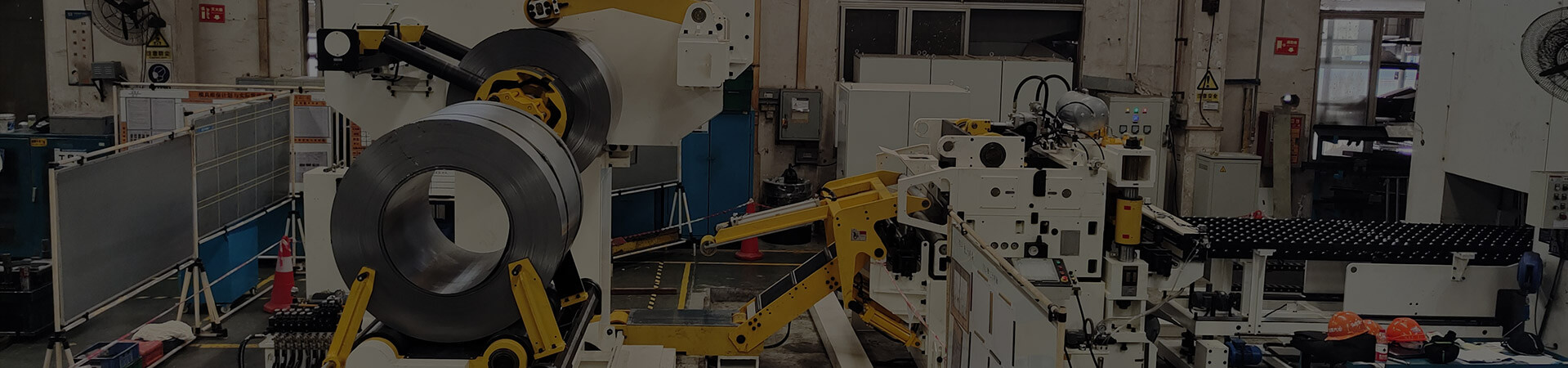
How a Decoiler Straightener Feeder Maximizes Productivity in Modern Metal Stamping Lines
In today's highly competitive manufacturing environment, efficiency, precision, and automation have become the key factors that determine production success. Whether producing automotive parts, home appliance components, electrical cabinets, metal furniture, or precision electronic products, manufacturers are continuously seeking equipment that can improve production efficiency while reducing labor costs and material waste.
One of the most important pieces of equipment in a coil-fed stamping production line is the Decoiler Straightener Feeder. Instead of using separate machines for decoiling, straightening, and feeding, manufacturers increasingly prefer integrated systems that combine all three functions into one compact and intelligent solution.
At SUNRUI MACHINE, we specialize in designing and manufacturing high-performance Decoiler Straightener Feeders for customers worldwide. Our equipment is engineered to deliver stable coil handling, precise feeding accuracy, excellent material flatness, and long-term reliability, helping manufacturers optimize their stamping operations and improve production efficiency.
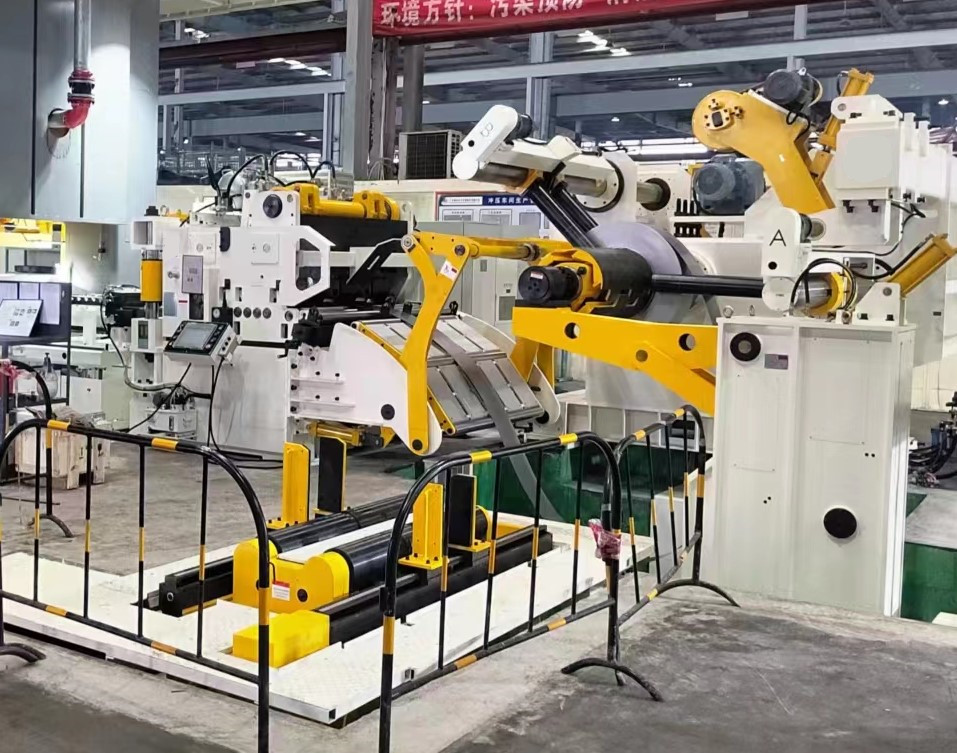
What Is a Decoiler Straightener Feeder?
A Decoiler Straightener Feeder is an integrated coil processing machine that combines three essential production processes into a single system:
Coil unwinding (Decoiling)
Material leveling (Straightening)
Automatic servo feeding (Feeding)
Instead of transferring material between three independent machines, the metal strip moves continuously through one integrated unit before entering the stamping press.This integrated design not only simplifies production but also significantly improves feeding accuracy, production speed, and workshop organization.The machine is commonly installed before mechanical presses, hydraulic presses, high-speed presses, laser cutting systems, punching machines, and roll forming production lines.
How Does a Decoiler Straightener Feeder Work?
Although the machine appears simple from the outside, each section performs an important task.
Step 1: Coil Loading
Metal coils are loaded onto the decoiler using an overhead crane, forklift, or coil car.The decoiler expands hydraulically or mechanically to securely hold the coil while allowing smooth rotation during production.Depending on production requirements, coil capacities may range from 300 kg to over 10 tons.
Step 2: Decoiling
The decoiler gradually unwinds the metal strip while maintaining stable tension.Proper decoiling is essential because excessive tension can deform the material, while insufficient tension may cause loose loops that interrupt production.Modern Decoiler Straightener Feeders often include:
Coil set
Cross bow
Edge wave
Surface distortion
Residual stress
These imperfections negatively affect stamping quality.The straightening section uses multiple precision-machined rollers arranged in alternating positions.As the strip passes through these rollers, the material is repeatedly bent in opposite directions, gradually eliminating internal stress and restoring flatness.The result is a flat, stable metal strip ready for precision stamping.
Step 3: Material Straightening
Metal coils naturally develop internal stress during rolling and storage.
If the material enters the stamping die directly from the coil, it may still contain:
Coil set
Cross bow
Edge wave
Surface distortion
Residual stress
These imperfections negatively affect stamping quality.
The straightening section uses multiple precision-machined rollers arranged in alternating positions.
As the strip passes through these rollers, the material is repeatedly bent in opposite directions, gradually eliminating internal stress and restoring flatness.
The result is a flat, stable metal strip ready for precision stamping.
Step 4: Servo Feeding
After straightening, the material enters the servo feeding system.A high-performance servo motor precisely controls feeding length according to the stamping program.The feeding system synchronizes with the press, ensuring each stroke receives the correct amount of material.Typical feeding accuracy can reach:±0.1 mmor even higher depending on the application.This level of precision is especially important for:
Progressive die stamping
Precision electronic components
Automotive brackets
High-speed stamping lines
Why Manufacturers Prefer Integrated Decoiler Straightener Feeders
More manufacturers are replacing traditional three-machine setups with integrated systems.
There are several important reasons.
1. Higher Production Efficiency
Using three independent machines requires more installation space, more wiring, and more synchronization.
An integrated machine eliminates unnecessary transfer processes.
Production becomes faster because:
Material travels a shorter distance.
Fewer operators are required.
Automatic synchronization reduces downtime.
Faster setup improves production flexibility.
The result is significantly higher productivity.
2. Better Feeding Accuracy
Modern stamping dies require extremely accurate feeding.
Even a small feeding error can lead to:
Product defects
Die damage
Material waste
Production stoppages
Servo-controlled feeding ensures every stroke maintains consistent feeding length.
This dramatically improves dimensional consistency.
3. Improved Material Flatness
Material flatness directly influences stamping quality.
Proper straightening provides:
Better die contact
Reduced spring-back
Improved bending quality
More stable punching
Better finished product appearance
Especially when processing high-strength steel, proper straightening becomes essential.
4. Lower Material Waste
Misfeeding is one of the biggest causes of scrap in stamping production.
Integrated feeding systems reduce:
Position errors
Feeding deviation
Material slipping
Coil instability
This minimizes scrap rates and reduces raw material costs.
5. Reduced Labor Costs
Traditional production lines often require multiple operators.
Integrated Decoiler Straightener Feeders automate most operations, including:
Coil unwinding
Material guiding
Feeding synchronization
Automatic control
As a result, manufacturers can reduce labor requirements while maintaining stable production.
6. Space Saving
Factory floor space is becoming increasingly valuable.
Replacing three separate machines with one integrated unit can save a considerable amount of production space.
The compact design also simplifies future production line expansion.
Materials Suitable for Decoiler Straightener Feeders
Modern Decoiler Straightener Feeders can process many different metal materials.
These include:
Cold Rolled Steel
Hot Rolled Steel
Stainless Steel
Galvanized Steel
Aluminum
Copper
Brass
High Strength Steel
Silicon Steel
Carbon Steel
Depending on material thickness and strength, different roller configurations and straightening capacities are available.
Typical Applications
Because of their versatility, Decoiler Straightener Feeders are widely used across many industries.
Automotive Industry
Automotive manufacturers require high-speed and high-precision stamping.
Typical products include:
Seat brackets
Reinforcement plates
Body structural parts
Chassis components
Engine brackets
Home Appliance Industry
Manufacturers of refrigerators, washing machines, air conditioners, and microwave ovens rely on automatic coil feeding for efficient production.
Electrical Industry
Electrical cabinets, switch boxes, transformer components, and cable accessories require precise feeding accuracy and excellent material flatness.
Electronics Industry
Small electronic parts often require extremely accurate feeding with minimal tolerance.
Servo feeding systems provide the precision needed for these applications.
Metal Furniture Industry
Cabinets, shelves, office furniture, storage systems, and metal frames are commonly produced using automatic stamping lines equipped with Decoiler Straightener Feeders.
Key Factors When Choosing a Decoiler Straightener Feeder
Not every machine is suitable for every production line.
Manufacturers should consider several important factors.
Coil Weight
Typical capacities include:
1 Ton
2 Ton
3 Ton
5 Ton
10 Ton
15ton
20ton
Choosing the correct capacity ensures stable operation and longer equipment life.
Material Width
Machine models are designed for different strip widths.
Selecting the proper width improves feeding stability.
Material Thickness
Thin materials require high feeding precision.
Thick materials require greater straightening force.
Different roller designs are used for different thickness ranges.
Feeding Accuracy
High-value products require servo feeding systems capable of maintaining extremely tight tolerances.
Production Speed
High-speed stamping lines require rapid acceleration and deceleration while maintaining stable synchronization.
Automation Requirements
Many manufacturers now integrate the Decoiler Straightener Feeder with:
Press control systems
PLC automation
Touch screen interfaces
Servo control systems
Safety monitoring
Production data management
These features help build smarter manufacturing systems.
Why Choose SUNRUI MACHINE?
At SUNRUI MACHINE, we believe that every customer deserves equipment designed specifically for their production requirements rather than a one-size-fits-all solution.
Our engineering team works closely with customers to understand their material specifications, production capacity, factory layout, and future expansion plans before recommending the most suitable equipment.
Our Decoiler Straightener Feeders are designed with robust mechanical structures, precision-machined rollers, reliable servo systems, and intelligent control technology to ensure long-term stable performance.
Every machine undergoes comprehensive quality inspection and performance testing before shipment to ensure it meets international quality standards.
With years of experience in coil handling automation, SUNRUI MACHINE has successfully supplied equipment to customers across Asia, Europe, the Middle East, South America, and other global markets.
Our advantages include:
Customized solutions for different production needs
High-precision servo feeding technology
Heavy-duty machine construction for long service life
Stable and reliable operation
Easy maintenance and user-friendly controls
Professional engineering consultation
Responsive after-sales technical support
Competitive pricing with excellent value
Whether you are building a new stamping production line or upgrading existing equipment, SUNRUI MACHINE can provide the right solution to improve productivity and reduce manufacturing costs.
Conclusion
As manufacturing continues to evolve toward greater automation, precision, and efficiency, the Decoiler Straightener Feeder has become an essential component of modern metal stamping production lines.
By integrating decoiling, straightening, and servo feeding into one compact system, manufacturers can significantly improve production speed, enhance product quality, reduce labor costs, minimize material waste, and optimize factory space.
Investing in a reliable Decoiler Straightener Feeder is not only an upgrade to your equipment—it is an investment in long-term productivity, manufacturing consistency, and business competitiveness.
At SUNRUI MACHINE, we are committed to providing innovative coil handling solutions that help manufacturers around the world achieve smarter, more efficient production.
If you are looking for a reliable Decoiler Straightener Feeder manufacturer, contact SUNRUI MACHINE today. Our experienced engineering team is ready to provide customized solutions that match your production requirements and support your business growth.